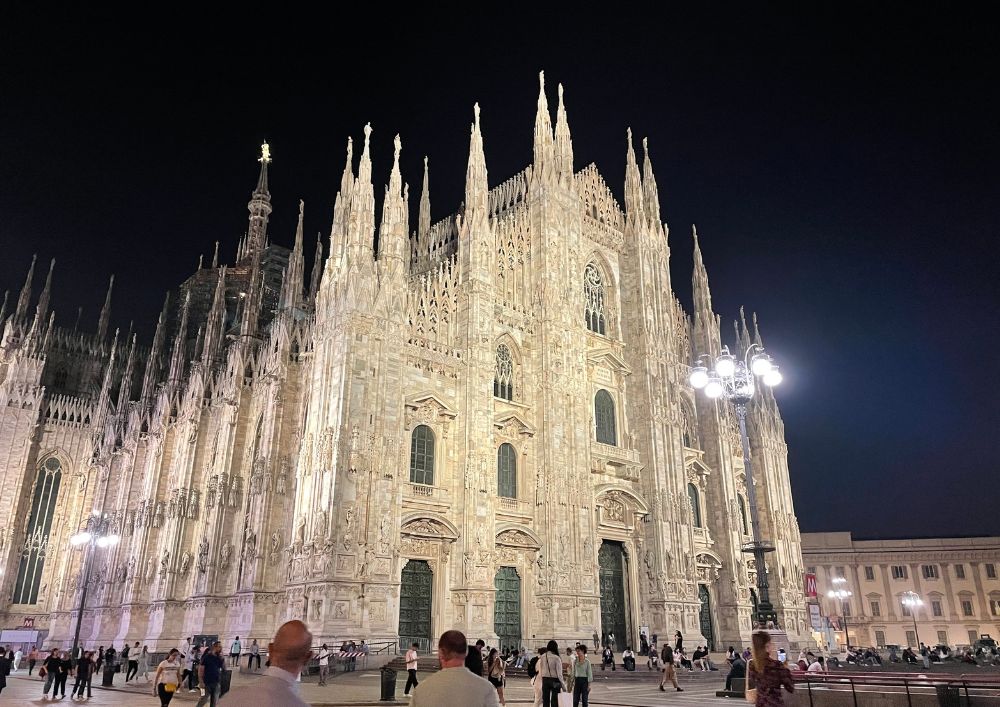
When people think of Milan, one of the first images that comes to mind is its magnificent Cathedral, the Duomo. Standing in the heart of the city, in Piazza del Duomo, this extraordinary monument is much more than a church. It is a symbol of Milan, a masterpiece of architecture and a fascinating story that has been unfolding for more than six centuries.
If you are planning a visit to the Duomo in Milan, Italy, you will discover a building full of surprises: a cathedral that took generations to complete, a roof where you can walk among marble spires, and even some curious Italian expressions connected to its construction.
Let’s discover the history, the secrets and the best ways to visit one of Italy’s most extraordinary monuments.
Duomo of Milan: how a red-brick Church became a Cathedral
The construction of Milan Cathedral began in 1386, at the time when Milan was ruled by the powerful Visconti family.
If you would like to discover more about the city and explore its most fascinating attractions, don’t miss our article Places to Visit in Milan, where you can find useful tips and inspiration for planning your visit and discovering the best that Milan has to offer!
But the original project was quite different from the building we see today. The first plan was to construct a large church using bricks, which were commonly used for buildings in northern Italy.
Everything changed when Gian Galeazzo Visconti, Lord of Milan, took control of the project. He wanted something much more ambitious: a magnificent Gothic cathedral inspired by the great churches of Northern Europe.
The decision was made to use marble instead of bricks. The stone came from the quarries of Candoglia, near Lake Maggiore, and was transported to Milan through canals and waterways.
The history of the façade is particularly interesting. For centuries, the front of the cathedral remained unfinished. In the 17th century, there were several discussions about how to complete it, including proposals for a more classical, Roman-style façade. The project changed several times, and the work continued over the following centuries.
The façade we admire today is therefore the result of a long and complicated process, combining different architectural influences. It was finally completed in 1813, although decorative work continued throughout the 19th and early 20th centuries.
The Cathedral Built by All the Milanese
The Duomo was not built by a single architect or a single generation of workers. It was a collective project involving thousands of people over many centuries.
In 1387, the Veneranda Fabbrica del Duomo was established to organise and supervise the construction. This institution still exists today and is responsible for the conservation and maintenance of the cathedral.
The building site attracted architects, engineers, sculptors, stonemasons and craftsmen from different parts of Europe. French and German masters, in particular, brought new ideas and techniques to Milan, working alongside local artisans.
This international collaboration helped create a building unlike any other in Italy.
The marble itself also has a fascinating story. Candoglia marble was transported to Milan without paying customs duties, thanks to a special privilege granted for the construction of the cathedral. The blocks were marked with the letters AUF, meaning Ad Usum Fabricae (for the use of the Fabbrica).
Even today, the Veneranda Fabbrica continues to employ skilled craftsmen who repair statues, restore decorations and preserve the cathedral.
In a way, the Duomo is still a living construction site!
Is the Duomo Really Gothic? Six Centuries of Architectural Changes
At first glance, the Duomo looks like a perfect example of Gothic architecture. But there is an interesting difference between its interior and exterior.
The interior is unmistakably Gothic. Its five naves, enormous pillars, pointed arches, ribbed vaults and magnificent stained-glass windows create the atmosphere typical of the great Gothic cathedrals of Northern Europe.
The exterior, however, tells a more complicated story.
The construction of the cathedral began in 1386, but the façade took centuries to complete. Different architects proposed different designs over time, introducing elements inspired by Renaissance and Classical architecture alongside Gothic decorations.
An important turning point came with Napoleon Bonaparte. On 26 May 1805, he crowned himself King of Italy inside the Duomo, placing the famous Iron Crown of the Lombards on his own head.
Napoleon also wanted the cathedral’s unfinished façade to be completed. He ordered the works to resume, and the project was developed by architects Giuseppe Zanoja and Carlo Amati. The façade was finally completed in 1813, although decorative work continued throughout the 19th century.
So, is the Duomo really Gothic?
Absolutely! Its interior is a remarkable example of European Gothic architecture, while its exterior, especially the façade, reflects centuries of changing architectural tastes.
Perhaps this is what makes the Duomo so fascinating: it is not simply a medieval cathedral, but a monument that tells more than six centuries of Milanese history.
Duomo Milan facts: Italian sayings born from the Cathedral
The Duomo has influenced not only the architecture of Milan but also its language. Some curious Italian expressions are traditionally connected to the construction of the cathedral.
La Fabbrica del Duomo
In Italian, the expression la Fabbrica del Duomo refers to the institution responsible for building and maintaining the cathedral.
But it has also become a popular expression to describe something that seems to go on forever.
You might hear someone say:
“È una storia lunga come la Fabbrica del Duomo!”
In other words: “It’s a story that never ends!”
The expression comes from the incredibly long construction of the cathedral, which began in 1386 and continued for centuries.
Mangiare a ufo
Have you ever heard the Italian expression mangiare a ufo?
It means eating for free, without paying.
One popular explanation connects this expression to the construction of the Duomo and the letters AUF (Ad Usum Fabricae) marked on the marble blocks.
The marble and other materials could travel to Milan without paying customs duties. According to a traditional story, the workers and people involved in transporting the materials also enjoyed certain privileges, including free meals.
Over time, the expression a ufo became associated with getting something for free.
Although the exact origin of the expression is debated, its connection with the Duomo is a lovely example of how the history of a monument can become part of everyday language.
Duomo Milan Terraces: Rooftop Concerts in the Sky
One of the most extraordinary experiences in Milan is visiting the terraces of the Duomo.
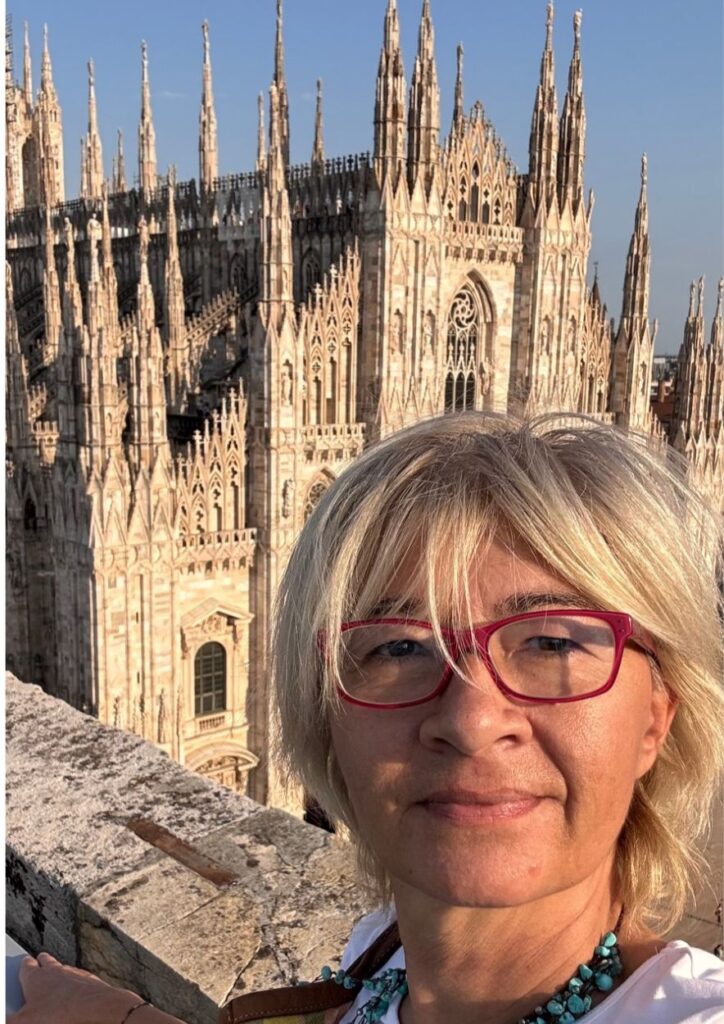
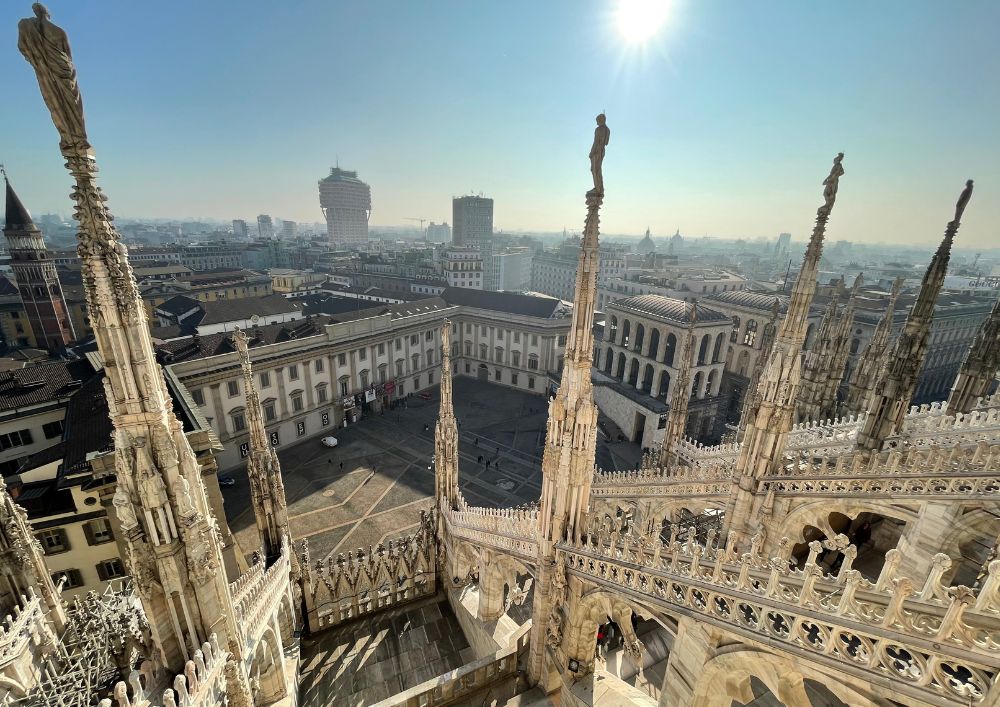
Unlike many other cathedrals, where the roof is not accessible to visitors, Milan Cathedral offers the possibility of walking among its marble spires, statues and flying buttresses.
You can reach the terraces by stairs or by lift. From up there, you can admire the extraordinary details of the architecture from very close, as well as enjoy a beautiful view over the city.
On clear days, you may even see the Alps in the distance.
Look carefully at the main spire: at its top stands the famous Madonnina, the golden statue of the Virgin Mary, installed in 1774. It has become one of the most recognisable symbols of Milan.
The terraces are also sometimes used for special cultural events. During the summer, the Duomo has hosted musical evenings, with live performances and concerts under the open sky.
Imagine listening to music surrounded by marble statues, with the Milan skyline in front of you. It is certainly a very special way to experience the city!
Event dates and programmes change every year, so check the official Duomo website before planning your visit.
Duomo Milan tour: visit the crypts
Most visitors admire the cathedral from the square, explore its interior and perhaps climb to the terraces. But there is another fascinating part of the Duomo that is easy to overlook: its underground history.
Beneath the cathedral and the square lie important archaeological remains of ancient Milan.
The Archaeological Area includes the remains of the Basilica of Santa Tecla and the Baptistery of San Giovanni alle Fonti, dating back to the early Christian period.
This is a particularly interesting place because it takes you back to a time long before the present cathedral existed.
The baptistery is traditionally associated with the baptism of Saint Augustine by Saint Ambrose in 387 AD.
Another place worth discovering is the Crypt of Saint Charles Borromeo, located beneath the cathedral’s presbytery.
Saint Charles Borromeo was Archbishop of Milan in the 16th century and played an important role in the history of the city and the Duomo. His remains are preserved in a richly decorated silver and crystal urn.
The crypt is a small but fascinating space, decorated with marble and precious materials.
Visiting these underground areas gives you a different perspective on the cathedral and helps you understand how many layers of history are hidden beneath the heart of Milan.
Practical tips before you go
If you are planning to visit the Duomo, here are a few useful tips to make the most of your experience.
1. Book your tickets in advance
The Duomo is one of the most popular attractions in Milan. Booking online can save you time, especially during weekends and the tourist season.
You can choose between different tickets, depending on whether you want to visit the cathedral, the terraces, the archaeological area or the museum.
2. Don’t miss the terraces
If you have enough time, I strongly recommend visiting the rooftop. Walking among the marble spires is an unforgettable experience and offers a completely different view of the cathedral.
3. Dress appropriately
Remember that the Duomo is an active place of worship. Shoulders and knees must be covered, and visitors should dress respectfully.
4. Allow enough time
A quick visit to the interior is not enough to appreciate all the details. If you also want to visit the terraces and the underground areas, allow at least two hours, preferably more.
5. Check opening times
Opening hours may change because of religious celebrations, special events or restoration work. Always check the official website before your visit.
6. Explore the area around the Duomo
Once you leave the cathedral, don’t rush away! Take some time to explore Piazza del Duomo, walk through the magnificent Galleria Vittorio Emanuele II and enjoy the atmosphere of the city centre.
The Duomo is not just a monument to visit. It is the perfect starting point for discovering Milan.
Duomo of Milan: FAQ
Planning a visit to Milan Cathedral? Here are some quick answers to the most common questions.
How long did it take to build the Duomo of Milan?
Construction began in 1386 and continued for almost six centuries. The main façade was completed in 1813, although decorative work continued into the 20th century (1965).
Can you walk on the roof of the Duomo in Milan?
Yes! Visitors can access the terraces by stairs or lift and walk among the marble spires and statues, enjoying spectacular views of Milan.
Is the Duomo of Milan really a Gothic cathedral?
Yes. Its interior is predominantly Gothic, while its exterior combines Gothic elements with architectural influences from other periods.
How much time do you need to visit the Duomo Milan?
Allow at least one hour for the cathedral and around two hours if you also want to visit the terraces. Plan for longer if you include the archaeological area and museum.