If you’ve ever studied Italian as an English speaker, you’ve probably had that moment of false confidence: you see a familiar-looking word and assume you understand it… only to realize later you were completely wrong. Welcome to the world of false cognates, also known as false friends.
These tricky word pairs look or sound similar across languages but have different meanings. They are one of the most fascinating, and frustrating, aspects of learning Italian, especially because they can lead to misunderstandings in everyday conversations.
False cognates: why do they exist?
False cognates exist because languages evolve over time, often borrowing words from common roots like Latin. While English and Italian share many Latin influences, the meanings of words can shift differently in each language over centuries.
In some cases, words that originally meant the same thing developed new meanings in one language but not the other. In other cases, words that simply look similar evolved from entirely different origins. The result is a linguistic “trap” that feels familiar but behaves unpredictably
Italian false cognates: the most common traps for English speakers
Because English and Italian share so many similar-looking words, it’s easy to assume direct translations will work. However, some of the most common everyday words are actually false friends.
For example:
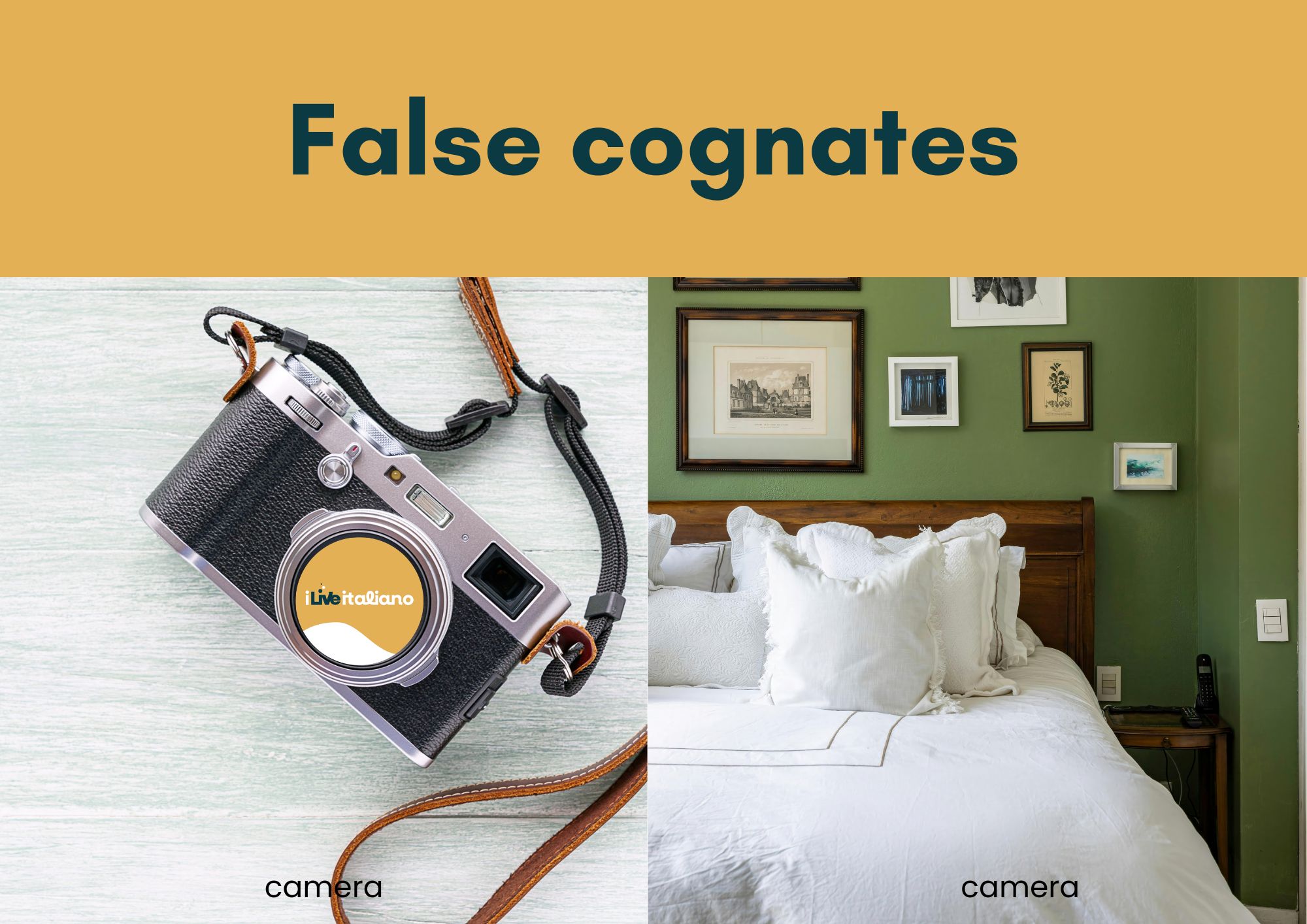
· “Camera” in Italian means room, not a device for taking photos
· “Parenti” doesn’t mean parents
· “Educazione” isn’t about school
Let’s explore the most common categories where these misunderstandings happen.
False cognates in everyday life and relationships
You cannot translate Parents as Parenti because Parenti means relatives and Genitori means parents (mom and dad). Saying “I live with my parenti” might confuse Italians about your living situation!
And so on:
- Confident ≠ Confidente → Confidente means someone you confide in (a close confidant or trusted friend), while confident (self-assured) is sicuro di sé or fiducioso.
- Education ≠ Educazione → Educazione means good manners, upbringing, or politeness (as in “Ha una buona educazione” = “He has good manners”), while education (schooling/learning) is istruzione.

Learning Italian vocabulary goes beyond avoiding false cognates. To truly sound natural, you also need to master the colorful expressions native speakers use every day. Explore our guide to Italian Idioms and take your fluency to the next level.
False cognates in health, emotions and feelings
Emotions can get lost in translation quickly.
- Addiction ≠ Addizione → Addizione means math addition (like 2+2), while addiction is dipendenza (e.g., dipendenza da alcol = alcohol addiction).
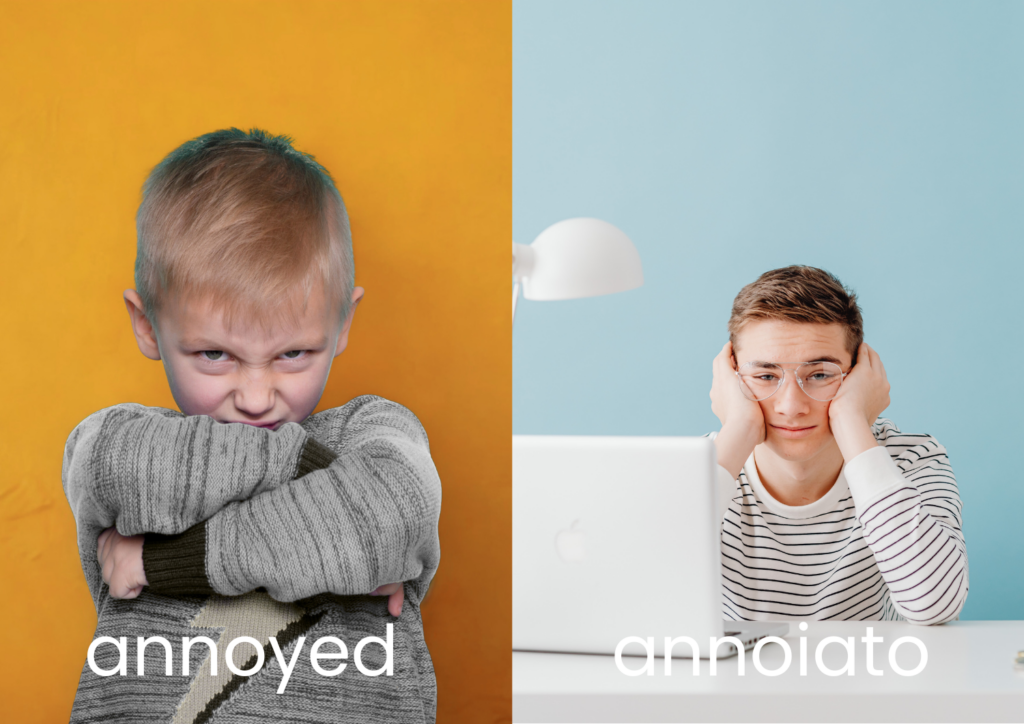
- Annoyed ≠ Annoiato → Annoiato means bored, while annoyed (irritated) is irritato or seccato.
- Deluded ≠ Deluso → Deluso means disappointed, while deluded (falsely believing something) is illuso or illudersi.
- Sensitive ≠ Sensitivo → Sensitivo refers to someone psychic or a medium (with supernatural sensitivity), while sensitive (emotionally or physically) is sensibile.
False cognates in language and communication
These can derail conversations entirely.
- Actually ≠ Attualmente → Attualmente means currently or at the moment, while actually (in reality, correcting a misconception) is in realtà or veramente.
- To pretend ≠ Pretendere → Pretendere means to demand or to claim (e.g., pretendere troppo = to demand too much), while to pretend (feign) is fingere.
- Argument ≠ Argomento → Argomento means topic, subject, or argument in the sense of reasoning (as in a debate point), while a heated quarrel is discussione or litigio.
- Finally ≠ Finalmente → Finalmente means at last (often with relief or satisfaction), while finally in a sequence is alla fine.
- Trivial ≠ Triviale → Triviale means vulgar or crude, while trivial (unimportant) is banale or insignificante.
False cognates in objects, places and spaces
Everyday items and locations cause frequent mix-ups.
- Library ≠ Libreria → Libreria means bookshop (or bookshelf), while library (where you borrow books) is biblioteca.
- Magazine ≠ Magazzino → Magazzino means warehouse or storage, while magazine (periodical) is rivista.
- Attic ≠ Attico → Attico means penthouse or top-floor apartment, while attic (under the roof for storage) is soffitta.
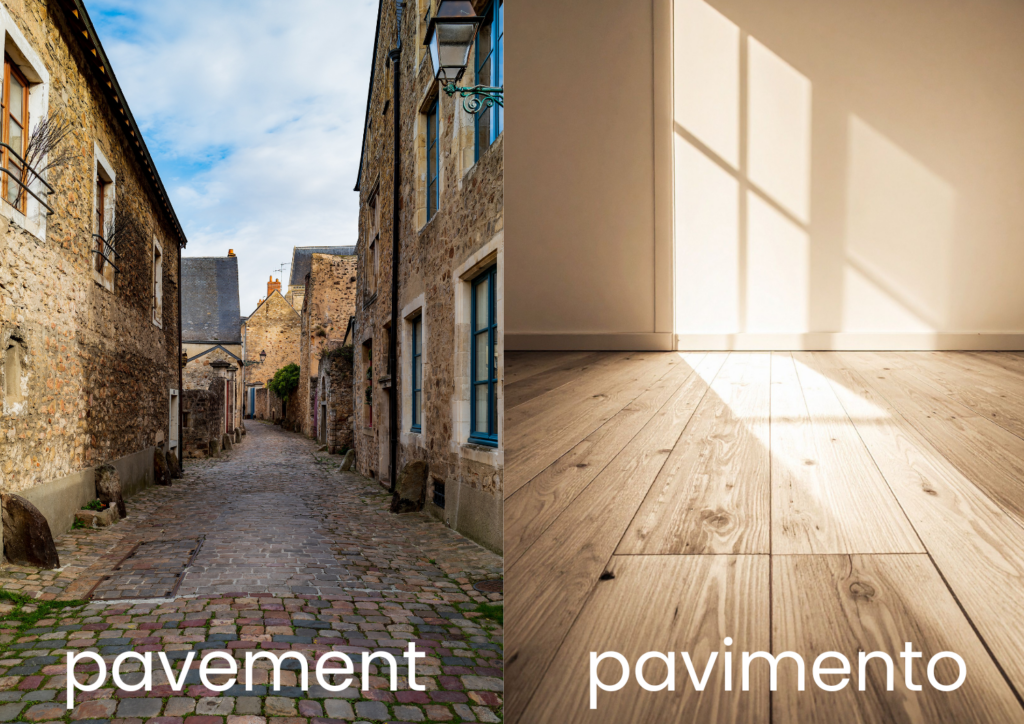
- Pavement ≠ Pavimento → Pavimento means floor (indoor surface), while pavement (sidewalk) is marciapiede.
False cognates in size, quality and characteristics
Describing things gets tricky here.
- Large ≠ Largo → Largo means wide (e.g., una strada larga = a wide street), while large (big in size) is grande.
- Effective ≠ Effettivo → Effettivo means actual or real (e.g., il numero effettivo = the actual number), while effective (successful/working well) is efficace.
- Disposable ≠ Disponibile → Disponibile means available or willing (e.g., Sono disponibile = I’m available), while disposable (single-use) is usa e getta.
False cognates in events and situations
- Accident ≠ Accidenti → Accidenti is an exclamation like “darn!” or “shoot!” (mild surprise/frustration), while accident (mishap) is incidente.
False Cognates: how to avoid them for good
The best way to avoid false cognates is awareness and practice. Instead of relying on how a word looks, focus on learning vocabulary in context, through real conversations, reading, and listening.
Creating personal examples, grouping words by theme, and actively noticing mistakes can also help you internalize the correct meanings. Over time, what once felt like a trap becomes second nature.
False Cognates English-Italian – FAQ
False cognates can be confusing at first, but understanding how they work makes them much easier to manage. Here are some common questions learners ask.
What exactly are false cognates?
False cognates are words in two languages that look or sound similar but have different meanings. Despite their appearance, they are not reliable translations of each other.
Are false cognates and false friends the same thing?
Yes, the terms are generally used interchangeably. “False friends” is the more informal and widely used expression, while “false cognates” is slightly more technical.
What are the most dangerous false cognates for English speakers learning Italian?
The most problematic ones are everyday words like attualmente, educazione, parenti, and pretendere, because they appear frequently and can easily lead to misunderstandings in real conversations
How can I remember which Italian words are false cognates?
The most effective method is to learn them in context rather than isolation. Associating each word with a real-life situation or sentence helps закреп their meaning. You can also keep a personal list of “tricky words” and review them regularly until they become automatic.