Italo Calvino stands as one of the most enchanting and innovative voices in 20th-century literature. Born in Cuba to Italian parents but deeply rooted in Italian soil, his works weave together fantasy, philosophy, and sharp social observation. For readers exploring Italian culture, Calvino offers a bridge between the country’s rich literary heritage, from Dante and Boccaccio to the modern era and playful, universal storytelling that continues to captivate global audiences.
Who was Italo Calvino? A brief biography
Italo Calvino was born on October 15, 1923, in Santiago de las Vegas, Cuba, where his father, Mario, an agronomist and botanist, was working. His mother, Eva Mameli, was also a botanist. The family soon returned to Italy, settling in San Remo on the Ligurian Riviera. Calvino’s upbringing in a scientifically inclined household fostered a lifelong appreciation for precise observation and the wonders of nature.
During World War II, he joined the Italian Resistance against the Nazis and Fascists, an experience that shaped his early realist works. After the war, he studied literature at the University of Turin, worked as a journalist for the Communist periodical L’Unità, and later became an editor at the prestigious Einaudi publishing house. Though he initially aligned with leftist politics, he grew disillusioned and left the Communist Party. Calvino traveled widely, lived in Paris for a time, and engaged with experimental literary groups like OuLiPo. He died on September 19, 1985, in Siena, Italy, at age 61, leaving behind a legacy of imaginative fiction that transcends genres.
Italo Calvino as a novelist: themes and style
Calvino’s style evolved from neorealism, grounded in his wartime experiences, to a unique blend of fable, allegory, science fiction, and postmodern experimentation. His prose is elegant, witty, and accessible, often featuring clear, vivid language that belies profound philosophical depth.
Central themes include the tension between reality and imagination, the search for meaning in a chaotic world, human connection to nature, and the act of storytelling itself. He explored individualism, utopia, memory, and the multiplicity of perspectives. Works like his “Our Ancestors” trilogy use fantastical premises to comment on society, while later novels play with narrative form, reader expectations, and the boundaries of literature. Calvino’s scientific curiosity infused his stories with cosmic wonder and structural precision, making him a “master storyteller” who entertains while inviting reflection.
Italo Calvino’s most famous books
If you’re new to Calvino, these are the novels most often recommended as the best introduction to his work:
- The Baron in the Trees (1957) – The story of Cosimo, a young nobleman who decides to spend his entire life among the trees, becoming a symbol of freedom and independence.
- The Cloven Viscount (1952) – A witty allegory about a nobleman literally split into two halves, exploring the duality of human nature.
- The Nonexistent Knight (1959) – A brilliant medieval fantasy featuring a knight who exists only through the strength of his will and perfect discipline.
- Invisible Cities (1972) – One of Calvino’s masterpieces, in which Marco Polo describes dozens of imaginary cities to Emperor Kublai Khan, each representing different aspects of human experience.
- If on a Winter’s Night a Traveler (1979) – An innovative and playful novel that places the reader at the center of the story, becoming a celebration of reading itself.
- Cosmicomics (1965) – A collection of imaginative stories inspired by scientific theories, where cosmic events become surprisingly human and humorous.
- Marcovaldo, or the Seasons in the City (1963) – Twenty charming stories following the everyday adventures of Marcovaldo, a humble worker searching for moments of beauty and nature in an increasingly industrial city.
The Baron in the Trees (Il barone rampante)
“The Baron in the Trees” is my personal favorite and often hailed as one of Calvino’s masterpieces. Set in 18th-century Liguria, it follows young Cosimo Piovasco di Rondò, who, after a quarrel with his parents over a plate of snails, climbs a tree and vows never to set foot on the ground again. He spends the rest of his life navigating an arboreal kingdom, engaging in adventures, romances, wars, and intellectual pursuits from the treetops.
The novel is a delightful philosophical conte that blends humor, adventure, and subtle allegory. Cosimo’s rebellion symbolizes the quest for personal freedom and authenticity in a conformist society. Through his elevated perspective, Calvino examines Enlightenment ideals, nature versus civilization, and the human condition with lightness and irony. Its charming premise, vivid imagery, and profound undertones make it an ideal entry point into Calvino’s world, whimsical yet deeply moving.
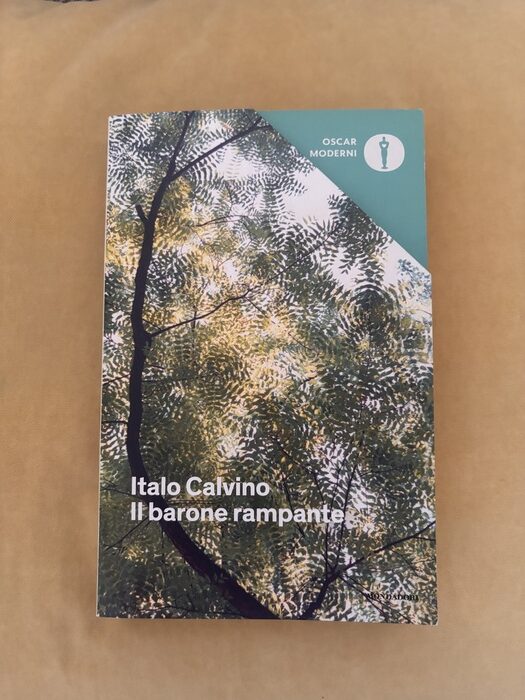
Quotations from “The Baron in the Trees” by Italo Calvino
Cosimo guardava il mondo dall’albero: ogni cosa, vista da lassù, era diversa e questo era già un divertimento.
Cosimo looked at the world from the tree: everything was different seen from up there, and that was already an entertainment.
Mio fratello sostiene che chi vuole guardare bene la terra deve tenersi alla distanza necessaria
My brother maintains, that those who wish to look carefully at the earth should stay at the necessary distance
Se alzi un muro, pensa a ciò che resta fuori!
If you build a wall, think of what’s left outside!
Why Italo Calvino still matters today
In an era dominated by digital fragmentation and information overload, Calvino’s emphasis on imagination, precise observation, and the joy of storytelling feels more relevant than ever. His works challenge readers to see the extraordinary in the ordinary, question rigid structures, and embrace multiple perspectives, skills vital for navigating modern complexities. As a champion of literature’s power to entertain and provoke thought, Calvino inspires writers and readers worldwide. His influence appears in contemporary fiction, urban studies (thanks to “Invisible Cities”), and even discussions of science and philosophy. For Italian culture enthusiasts, he embodies the nation’s inventive spirit: rooted in history yet boldly forward-looking.
Italo Calvino – FAQ
Italo Calvino’s rich body of work raises many questions for new readers. Here are answers to some of the most common ones.
Which Italo Calvino book should I read first?
“Marcovaldo or the Seasons in the City” is an excellent starting point, with its accessible, episodic stories about an ordinary worker’s quiet struggles and dreams amid urban life. It offers a gentle introduction to Calvino’s observational style and subtle humor.
Follow it with “The Baron in the Trees” for a more adventurous and philosophical fable that captures his imaginative brilliance.
What is Italo Calvino known for?
He is known for blending fantasy, fable, and philosophy in innovative narratives that explore reality, imagination, and the art of storytelling itself.
What is Italo Calvino’s most famous book?
“Invisible Cities” (1972) is widely regarded as his most iconic, though “If on a Winter’s Night a Traveler” and “The Baron in the Trees” are close contenders.
What genre is Italo Calvino?
Calvino defies strict categorization but is often associated with magical realism, postmodernism, fabulism, and speculative fiction.
Is Italo Calvino a novelist or a short story writer?
He excelled at both. Many of his novels incorporate short-story-like structures, and collections like “Cosmicomics” showcase his mastery of the shorter form.
Why is “Invisible Cities” considered Calvino’s masterpiece?
Invisible Cities is celebrated for its poetic innovation, structural brilliance, and profound meditation on cities, memory, desire, and the imagination. Through 55 dreamlike descriptions framed as Marco Polo’s tales to Kublai Khan, Calvino explores how we construct meaning and perceive reality, making it a pinnacle of postmodern literature and one of the most influential books of the 20th century.
How many cities are in Italo Calvino in Invisible Cities?
There are 55 cities described in the book.
Calvino’s stories invite us to climb our own trees, to view the world from new heights and rediscover the magic in everyday life. Whether you’re new to Italian literature or a longtime fan, his works promise delight and discovery.