If you’ve spent any time around Italians or Italian media, you’ve probably noticed that people don’t always say “you” the same way. One of the most important pieces of Italian honorifics is the formal Lei. Mastering it helps you sound polite, respectful, and culturally aware, especially when you’re meeting new people or navigating everyday situations in Italy.
What is “dare del Lei”? Meaning and origins
“Dare del Lei” literally means “to give the Lei” and simply means addressing someone with the formal “you.” The opposite is “dare del tu” (using the informal tu).
This formal form has been part of Italian for about five centuries. It came into wider use under Spanish influence (similar to Spanish usted) and grew out of older courtly ways of speaking politely through third-person titles. Over time it settled into the standard polite singular form used across most of Italy. Interestingly, during the Fascist period in the 1930s there was an official push to replace Lei with voi because Lei was seen as foreign and too “feminine,” but after the war Lei returned as the normal formal choice.
Lei vs. tu: when to use the formal address in Italian
Use tu with family, close friends, children, people your own age in casual settings, and anyone who has invited you to be informal.
Use Lei with strangers (especially adults), older people you don’t know well, professionals (doctors, teachers, lawyers, officials), and in most service or work situations, shops, banks, hotels, restaurants, offices. When in doubt, start with Lei. Italians usually find over-politeness harmless; starting too casually can feel rude. In southern Italy you may still hear the older formal singular voi in some places, especially among older speakers, but Lei remains the standard polite form nationwide.

How to conjugate verbs with the formal Lei
Grammatically, Lei behaves like the third-person singular (“he/she”). That means the verb looks the same as when you talk about lui or lei, even though you’re speaking directly to the person and it works for both men and women.
Examples:
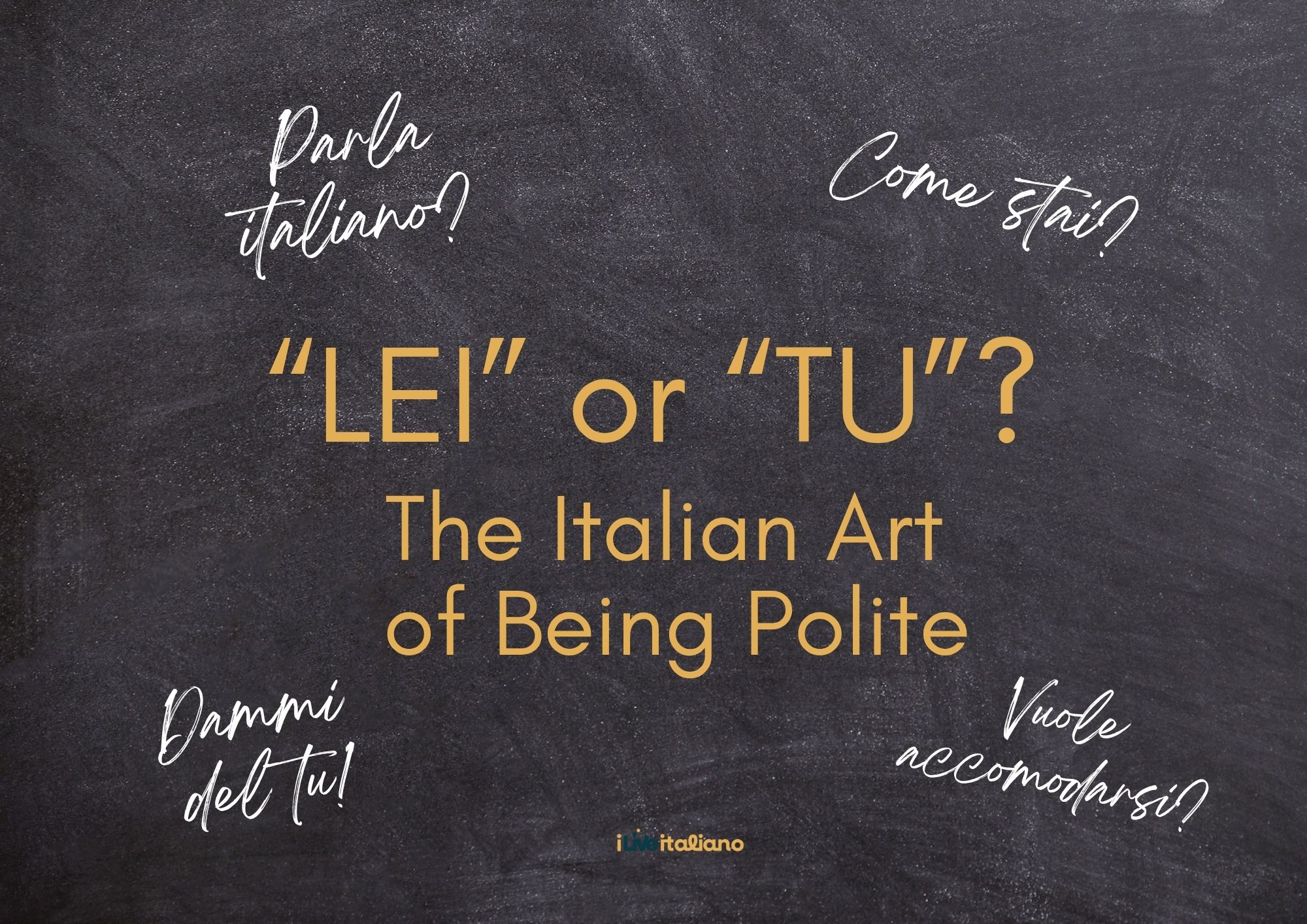
- Informal: Come stai? → Formal: Come sta?
- Informal: Vuoi un caffè? → Formal: Vuole un caffè?
- Informal: Parli italiano? → Formal: Parla italiano?
- Informal: Sei di Roma? → Formal: È di Roma?
Object pronouns and possessives also shift: ti becomes La/Le, tuo/tua becomes Suo/Sua. In formal writing you often see these capitalized (La ringrazio, La Sua lettera) to show respect and avoid confusion with “she/her.”

Common mistakes when using Lei in Italian
- Mixing the pronoun and the verb: saying Lei sei instead of Lei è.
- Using tu too quickly with strangers, shop staff, or older people.
- Staying with Lei forever once a relationship has clearly become friendly (it can feel stiff or distant).
- Forgetting that adjectives and past participles usually stay masculine when referring to a man addressed as Lei (e.g., Lei è stato molto generoso).
- Over-capitalizing or under-capitalizing in writing—capital Lei is traditional in formal letters, but everyday writing is more flexible.

When can you switch from Lei to tu?
The switch usually happens when the relationship becomes warmer or more equal. The other person often makes the first move with phrases like:
- Diamoci del tu!
- Possiamo darci del tu?
- Dammi pure del tu.
You can also ask politely: Posso darle del tu? or Posso darti del tu? Once someone offers the tu, accept it; it’s a friendly signal. In workplaces, tech and creative environments tend to move to tu faster than traditional fields like law, medicine, or government.

Italian honorifics: titles that go with Lei
Lei almost always pairs with a title:
- Signor + last name (for men)
- Signora + last name (for women)
- Professional titles: Dottore/Dottoressa, Professore/Professoressa, Avvocato, Ingegnere, etc.
So you’ll hear Signor Rossi, come sta? or Dottoressa Bianchi, vuole accomodarsi? Using the title plus Lei is the classic polite package. Signorina is rarely used nowadays.
The formal Lei. FAQ
What does “dare del Lei” mean?
It means to address someone with the formal Lei instead of the informal tu.
Is Lei always capitalized in Italian?
Not always. In formal letters and official writing it traditionally is (along with La, Le, Suo), mainly to distinguish it from lei = “she.” In everyday writing capitalization is optional and less common.
When should I use Lei instead of tu?
With adults you don’t know well, older people, professionals, and in most formal or service situations. When unsure, choose Lei.
Is Lei used differently in southern Italy?
The rules are the same, but in parts of the South (especially among older speakers) the traditional formal singular voi can still appear alongside or instead of Lei. Younger people and standard usage prefer Lei everywhere.